
LDR Sensor

Written by
Atribot team
Last updated
June 10, 2026
Introduction
Have you ever noticed how street lights automatically turn ON at night and switch OFF during the day? Or how some devices automatically adjust their screen brightness based on surrounding light conditions? These smart features are often made possible by a simple light-sensing component known as an LDR Sensor.
An LDR (Light Dependent Resistor) is a sensor whose resistance changes according to the amount of light falling on its surface. When exposed to bright light, its resistance decreases, and when placed in darkness, its resistance increases. This unique property allows electronic circuits to detect and respond to changing light conditions.
Due to its simplicity, low cost, and ease of use, the LDR sensor is widely used in automatic lighting systems, smart home devices, solar tracking systems, and various automation projects.
In this article, you will learn about the LDR sensor's main parts, pin configuration, technical specifications, working principle, advantages, disadvantages, and real-world applications.
Main Parts
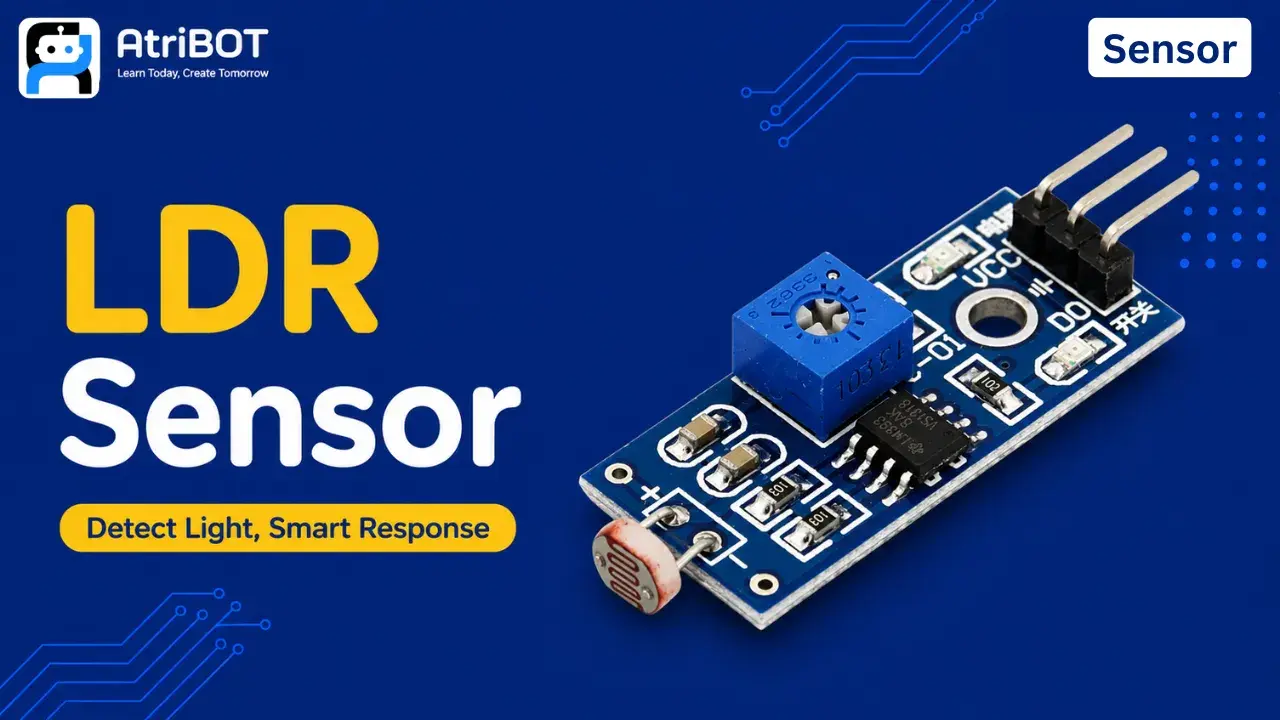
A typical LDR Sensor Module consists of several components that work together to detect and process light intensity.
LDR (Light Dependent Resistor): The LDR is the primary sensing element of the module. Its resistance changes based on the amount of light falling on its surface. Higher light intensity results in lower resistance, while lower light intensity increases resistance.
LM393 Comparator IC: The comparator IC processes the voltage generated by the LDR and compares it with a reference voltage. Based on this comparison, it generates a digital output signal indicating whether the light level has crossed a predefined threshold.
Potentiometer: The onboard potentiometer allows users to adjust the light sensitivity of the sensor module. By rotating the potentiometer, the threshold light level can be increased or decreased according to the application.
Indicator LEDs: Most LDR modules include power and status LEDs. These LEDs provide visual feedback about the module's operating condition and detection status.
Output Header Pins: The header pins provide power and output connections between the sensor module and a microcontroller such as Arduino or ESP32.
Pinouts
A typical LDR sensor module contains three pins.
Pin | Description |
|---|---|
VCC | Power Supply |
GND | Ground |
DO | Digital Output |
VCC: Provides power to the sensor module. Most modules operate with 3.3V to 5V DC.
GND: Acts as the common ground connection for the module.
DO(Digital Output): Outputs a HIGH or LOW signal depending on the detected light level and the threshold set using the potentiometer.
Specifications
Parameter | Specification |
|---|---|
Operating Voltage | 3.3V – 5V DC |
Operating Current | Less than 20mA |
Sensor Type | Photoresistor (LDR) |
Comparator IC | LM393 |
Output Type | Digital Output |
Sensitivity Adjustment | Onboard Potentiometer |
Detection Method | Light Intensity Detection |
Response Time | Fast |
Operating Temperature | -20°C to 70°C |
Working Principle
The LDR sensor works on the principle of photoconductivity, where the electrical resistance of the LDR changes according to the amount of light falling on its surface.
Light Detection: When light falls on the surface of the LDR, photons strike the semiconductor material and increase the number of free charge carriers. This reduces the resistance of the LDR.
Resistance Variation: In bright conditions, the resistance becomes very low. In dark conditions, the resistance increases significantly. This change in resistance creates a corresponding change in voltage across the sensor circuit.
Signal Processing: The LM393 comparator continuously monitors the voltage generated by the LDR and compares it with a preset reference value determined by the potentiometer.
Output Generation: If the detected light level crosses the predefined threshold, the comparator changes the state of the output pin, generating a digital HIGH or LOW signal.
Automatic Response: This output signal can then be used by a microcontroller or automation system to perform actions such as turning lights ON or OFF, activating alarms, or controlling other electronic devices.
Advantages & Disadvantages
LDR sensors are widely used because they provide a simple and cost-effective method of detecting light intensity. However, they also have certain limitations.
Advantages
Low cost
Easy to use
Simple circuit design
Low power consumption
Adjustable sensitivity
Good light detection capability
Widely available
Suitable for automation projects
Disadvantages
Slower response compared to photodiodes
Affected by environmental conditions
Less accurate for precise light measurements
Performance may vary with temperature
Limited sensitivity range in some applications
Applications
LDR sensors are used in many electronic and automation systems that require light detection and automatic response.
Automatic Street Lights: LDR sensors detect ambient light levels and automatically switch street lights ON at night and OFF during the day.
Smart Home Lighting: These sensors are used in home automation systems to control indoor and outdoor lighting based on surrounding brightness.
Solar Tracking Systems: LDR sensors help solar panels track the direction of maximum sunlight to improve energy generation efficiency.
Light Intensity Monitoring: They are used in systems that continuously monitor environmental light conditions.
Security Systems: LDR sensors can detect changes in light levels caused by movement or obstruction and trigger alarms.
Camera Light Meters: Many light-measuring devices use LDRs to estimate ambient light levels.
Automatic Garden Lights: LDR sensors automatically control decorative and garden lighting systems.
Educational Electronics Projects: LDR sensors are commonly used in Arduino and microcontroller projects to teach light sensing and automation concepts.
Industrial Automation: Factories use LDR sensors for light-based detection and monitoring applications.
Day-Night Detection Systems: LDR sensors help electronic systems determine whether it is daytime or nighttime and respond accordingly.
The LDR Sensor is one of the simplest and most widely used light-sensing components in electronics, providing an affordable and effective solution for detecting and responding to changes in ambient light.