
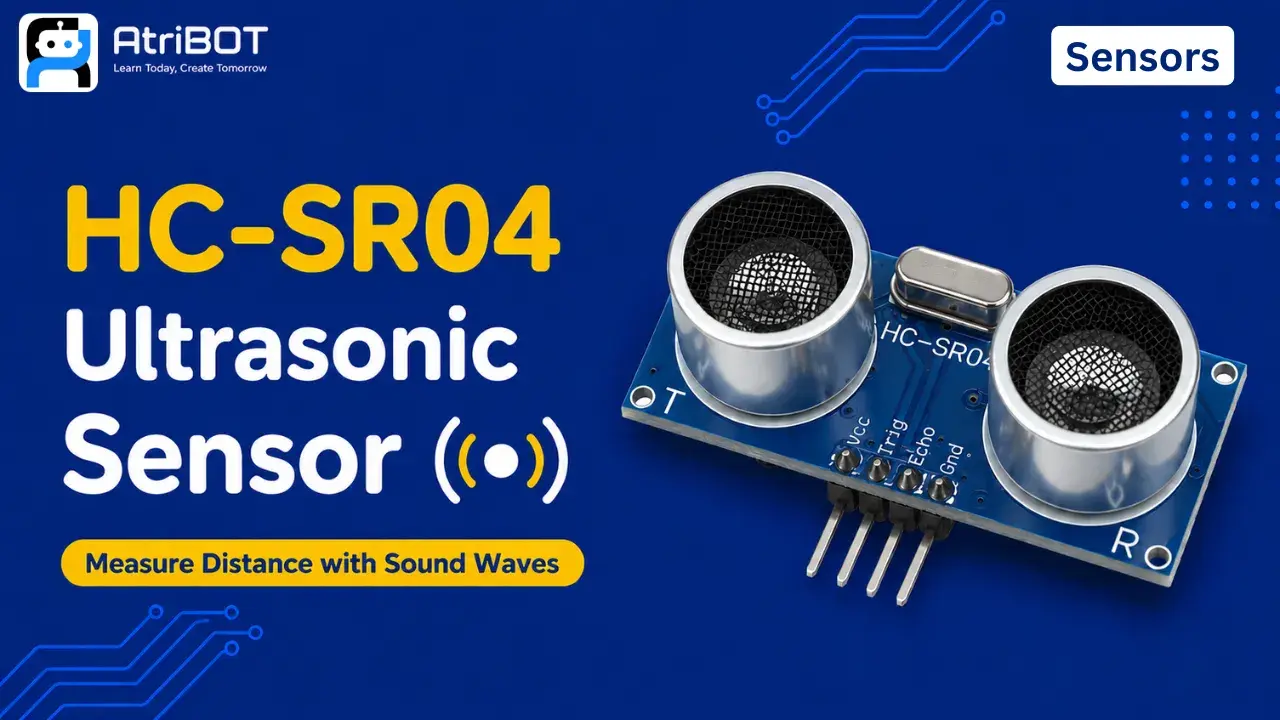
HC-SR04 Ultrasonic Sensor

Written by
Atribot team
Last updated
June 10, 2026
Introduction
What if you could measure the distance to an object without touching it? Whether it's a robot avoiding obstacles, a smart parking system detecting vehicles, or a water tank monitoring its level, accurate distance measurement is essential in many modern electronic systems.
The HC-SR04 Ultrasonic Sensor is one of the most widely used distance sensors in electronics and robotics. Instead of relying on light, it uses ultrasonic sound waves to detect objects and calculate their distance. This makes it reliable in various lighting conditions and suitable for many automation projects.
Thanks to its affordability, accuracy, and ease of use, the HC-SR04 has become a favorite among students, hobbyists, and engineers. It is commonly used in robotics, obstacle detection systems, smart automation projects, and educational electronics applications.
In this article, you will learn about the HC-SR04 sensor's main parts, pin configuration, technical specifications, working principle, advantages, disadvantages, and real-world applications.
Main Parts
1. Transmitting Transducer
The transmitting transducer generates ultrasonic sound waves at a frequency of 40 kHz.
Functions:
Produces ultrasonic pulses
Sends sound waves toward objects
Initiates the distance measurement process
2. Receiving Transducer
The receiving transducer detects ultrasonic waves reflected from nearby objects.
Functions:
Receives reflected sound waves
Converts sound signals into electrical signals
Helps determine object distance
3. Oscillator
The oscillator generates the required frequency for ultrasonic transmission.
Functions:
Produces stable 40 kHz signals
Drives the transmitting transducer
Ensures accurate measurements
4. LM324 Operational Amplifier
The LM324 is used to process ultrasonic signals.
Functions:
Amplifies received signals
Filters unwanted noise
Improves detection accuracy
5. MAX3232 IC
The MAX3232 assists with signal processing and communication functions.
Functions:
Performs voltage level conversion
Supports serial communication requirements
Enhances signal reliability
Pinouts
The HC-SR04 sensor contains four pins.
Pin | Description |
|---|---|
VCC | Power Supply (5V) |
Trig | Trigger Input |
Echo | Echo Output |
GND | Ground |
VCC
Provides power to the sensor module.
Trig
Receives a trigger pulse that starts ultrasonic transmission.
Echo
Outputs a pulse whose duration corresponds to the measured distance.
GND
Provides the common ground connection.
Specifications
Parameter | Specification |
|---|---|
Operating Voltage | 5V DC |
Operating Current | 15mA |
Working Frequency | 40kHz |
Measuring Range | 2cm – 400cm |
Measuring Angle | 15° |
Distance Accuracy | ±3mm |
Trigger Signal | 10µs TTL Pulse |
Output Signal | TTL Pulse |
Operating Temperature | -15°C to 70°C |
Dimensions | 45mm × 20mm × 15mm |
Working Principle
The HC-SR04 works on the principle of ultrasonic wave reflection.
Step 1: Trigger Signal
A 10-microsecond pulse is applied to the Trig pin.
Step 2: Ultrasonic Transmission
The sensor transmits eight ultrasonic pulses at 40 kHz.
Step 3: Object Reflection
The sound waves travel through the air and reflect from an object's surface.
Step 4: Echo Reception
The receiving transducer detects the reflected ultrasonic waves.
Step 5: Distance Calculation
The sensor calculates the distance based on the time taken for the sound waves to travel to the object and return.
Advantages & Disadvantages
The HC-SR04 is widely used because of its accuracy and simplicity. However, it also has certain limitations.
Advantages
Accurate distance measurement
Non-contact sensing
Low cost
Easy to interface
Low power consumption
Wide measuring range
Reliable performance
Suitable for robotics applications
Disadvantages
Affected by soft surfaces
Limited detection angle
Cannot operate in a vacuum
Sensitive to environmental conditions
Difficulty detecting very small objects
Slower than some laser-based sensors
Applications
The HC-SR04 is used in a wide variety of electronic and automation systems.
1. Obstacle Avoidance Robots
Detects obstacles and helps robots navigate safely.
2. Distance Measurement Systems
Measures the distance between the sensor and objects.
3. Automatic Parking Systems
Assists in vehicle parking by detecting nearby obstacles.
4. Water Level Monitoring
Measures liquid levels in tanks and containers.
5. Smart Dustbins
Detects hand movement and automatically opens the lid.
6. Security Systems
Detects nearby movement and object presence.
7. Industrial Automation
Used for object detection and process monitoring.
8. Smart Traffic Systems
Supports vehicle detection and traffic monitoring.
9. Drone and Robot Navigation
Helps autonomous systems avoid collisions.
10. IoT and Smart Projects
Used in various automation and smart monitoring applications.
The HC-SR04 Ultrasonic Sensor is one of the most popular distance measurement sensors in electronics because it offers a simple, accurate, and affordable solution for non-contact object detection and distance measurement.