
LED

Written by
Atribot team
Last updated
June 10, 2026
Introduction
Have you ever wondered how electronic devices indicate power status, notifications, or activity? One of the most common components responsible for these visual indications is the LED (Light Emitting Diode).
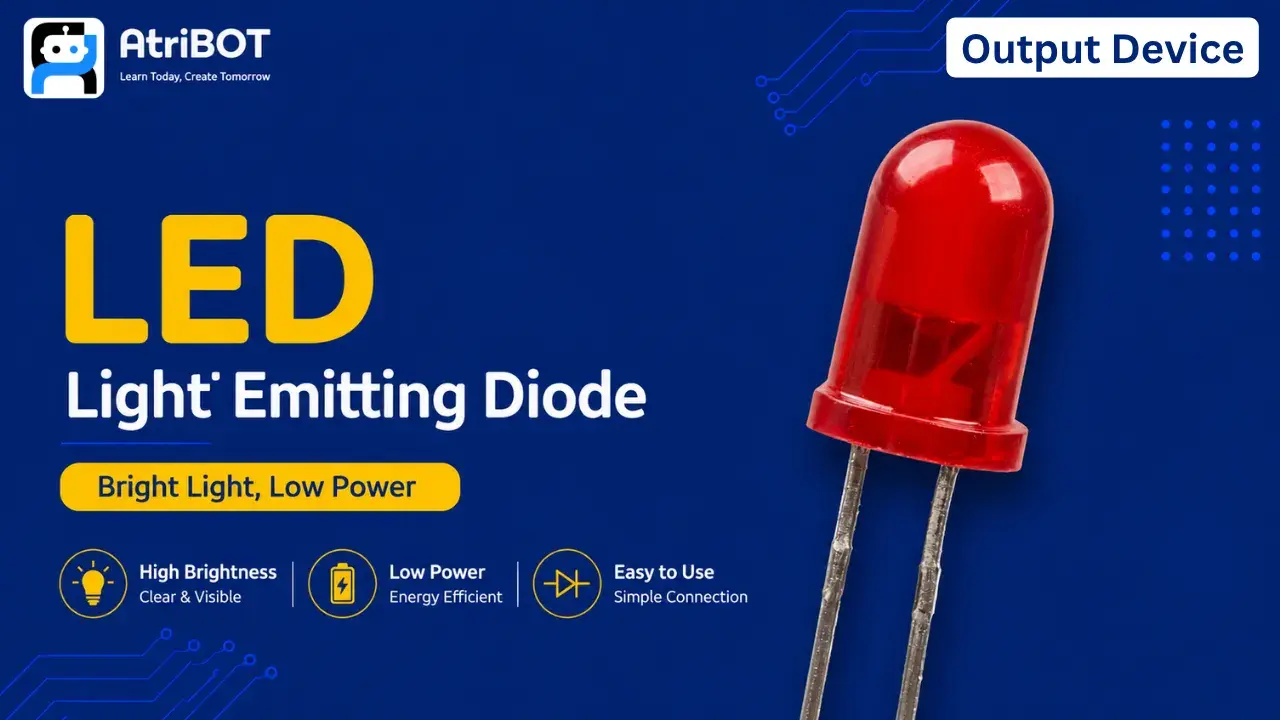
An LED is a semiconductor device that emits light when an electric current passes through it. Due to its low power consumption, long lifespan, and compact size, LEDs are widely used in electronic circuits, displays, indicators, lighting systems, and automation projects.
From simple Arduino projects to advanced industrial systems, LEDs play an important role in providing visual feedback and status indications. Their ability to produce bright light with minimal power consumption has made them one of the most popular output devices in modern electronics.
In this article, you will learn about the LED's main parts, pin configuration, technical specifications, working principle, advantages, disadvantages, and real-world applications.
Main Parts
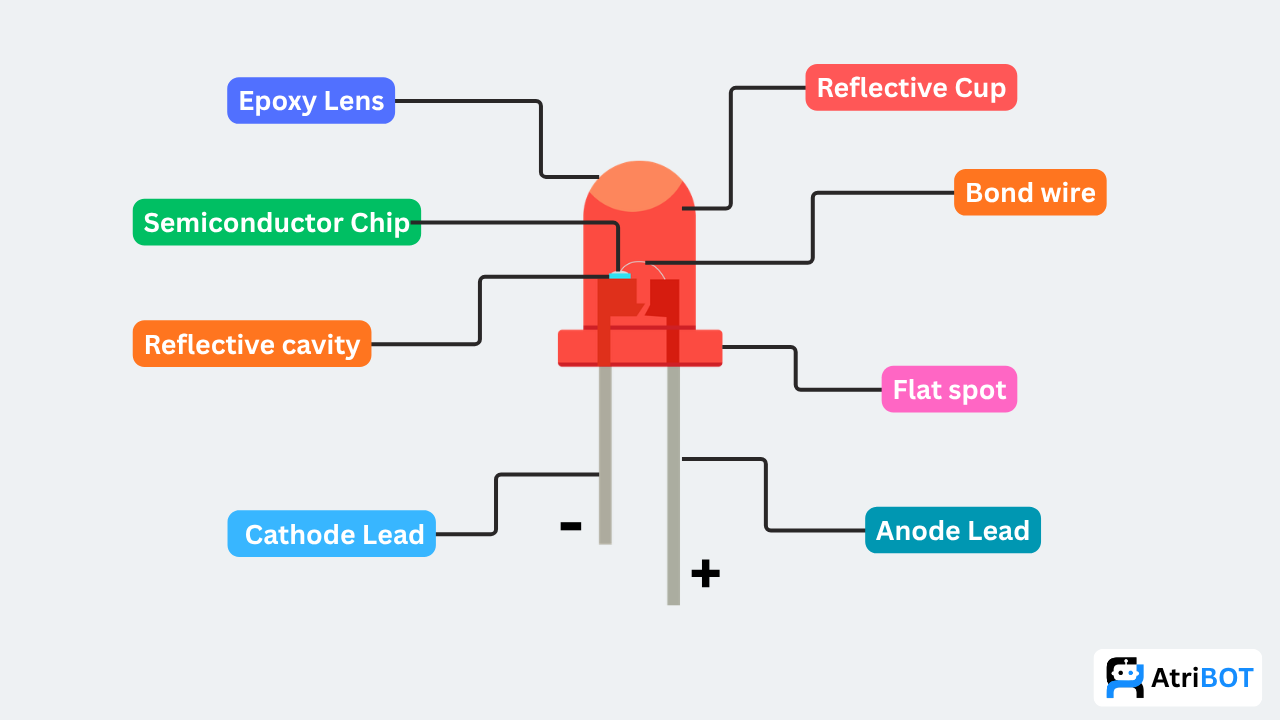
The LED consists of several internal and external components that work together to produce light when current flows through it.
1. Epoxy Lens
The epoxy lens is the transparent outer covering of the LED.
Functions:
Protects internal components
Focuses and directs light
Improves light visibility
2. Semiconductor Chip
The semiconductor chip is the core light-producing element inside the LED.
Functions:
Converts electrical energy into light
Determines the color of the LED
Produces light through electroluminescence
3. Reflective Cup
The reflective cup surrounds the semiconductor chip.
Functions:
Reflects light outward
Increases brightness
Improves light efficiency
4. Reflective Cavity
The reflective cavity holds the semiconductor chip inside the LED structure.
Functions:
Supports the semiconductor chip
Reflects emitted light toward the lens
Enhances light output
5. Bond Wire
The bond wire is a very thin conductive wire that connects the semiconductor chip to the LED lead.
Functions:
Transfers electrical current to the semiconductor chip
Establishes internal electrical connections
Ensures proper LED operation
6. Anode Lead (+)
The anode lead is the positive terminal of the LED and is usually the longer lead.
Functions:
Receives positive voltage
Allows current to enter the LED
7. Cathode Lead (-)
The cathode lead is the negative terminal of the LED and is usually the shorter lead.
Functions:
Provides the return path for current
Connects to ground in most circuits
8. Flat Spot
The flat spot is located on the edge of the LED body.
Functions:
Identifies the cathode terminal
Helps determine LED polarity during circuit connections
Together, these components enable the LED to efficiently convert electrical energy into visible light, making it one of the most widely used output devices in electronics.
Pinouts
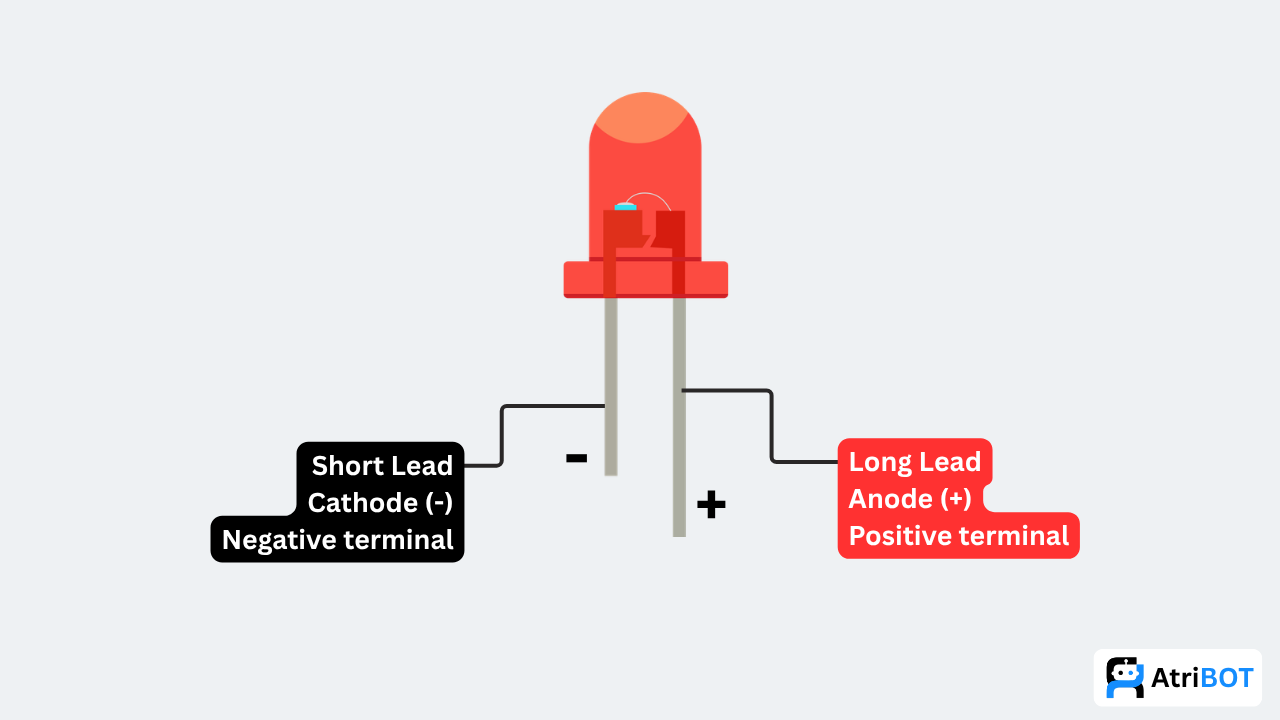
An LED typically has two terminals.
Pin | Name | Description |
|---|---|---|
Long Lead | Anode (+) | Positive terminal |
Short Lead | Cathode (-) | Negative terminal |
Identifying LED Pins
Longer leg → Anode (+)
Shorter leg → Cathode (-)
Flat edge on the LED body → Cathode (-)
Specifications
Parameter | Specification |
|---|---|
Operating Voltage | 1.8V – 3.3V |
Operating Current | 10mA – 20mA |
Power Consumption | Low |
Response Time | Nanoseconds |
Lifespan | Up to 50,000 Hours |
Viewing Angle | 15°–120° |
Available Colors | Red, Green, Blue, Yellow, White |
Working Principle
An LED works on the principle of electroluminescence.
When a forward voltage is applied across the LED:
Current flows from the anode to the cathode.
Electrons and holes recombine inside the semiconductor material.
Energy is released in the form of light.
The LED glows.
The color of the emitted light depends on the semiconductor material used inside the LED.
Advantages & Disadvantages
LEDs are popular because they are efficient, reliable, and easy to use. However, they also have some limitations depending on the application.
Advantages
Low power consumption
Long lifespan
Fast switching speed
Small size
High efficiency
Available in multiple colors
Generates very little heat
Environment friendly
Disadvantages
Requires proper current limiting resistor
Brightness decreases over time
Sensitive to reverse voltage
Limited illumination range
Can be damaged by excessive current
Applications
LEDs are used in a wide variety of electronic and electrical systems.
1. Power Indicators
Used to indicate power status in electronic devices.
2. Arduino Projects
Used for learning and testing output control.
3. Traffic Signals
Widely used in traffic lights due to low power consumption.
4. Display Systems
Used in digital displays and signboards.
5. Automotive Lighting
Used in headlights, brake lights, and indicators.
6. Home Lighting
Used in LED bulbs and decorative lighting systems.
7. Industrial Equipment
Used for status indication and machine monitoring.
8. Communication Systems
Used in optical communication and fiber optic systems.
9. Consumer Electronics
Found in TVs, laptops, chargers, and home appliances.
10. Emergency Lighting
Used in backup and emergency lighting systems.
LEDs are one of the most important output devices in electronics because they provide a simple and efficient way to convert electrical energy into visible light.