
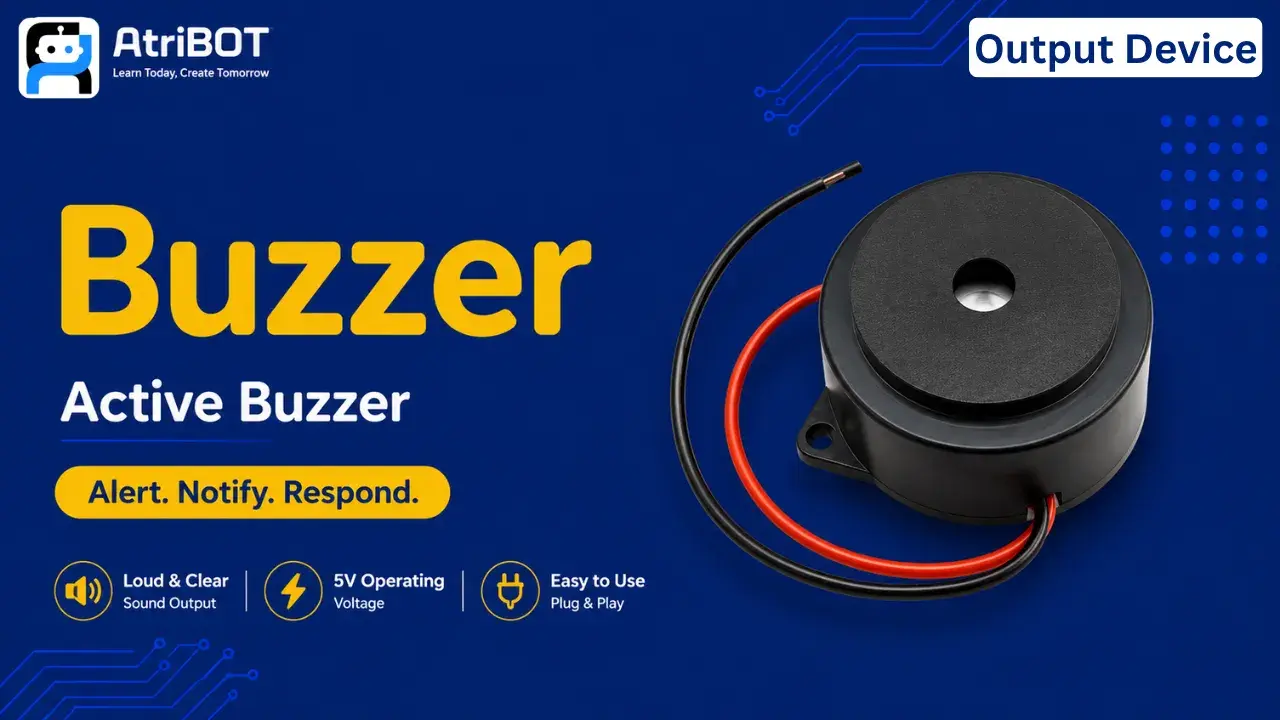
Buzzer

Written by
Atribot team
Last updated
June 10, 2026
Introduction
Have you ever wondered how an alarm clock beeps, a microwave notifies you when cooking is complete, or a security system alerts you during an intrusion? These sound notifications are often produced by a simple electronic component known as a Buzzer.
A buzzer is an output device that converts electrical energy into sound energy. It is widely used in electronic circuits to provide audible alerts, warnings, and notifications. Depending on the design, buzzers can produce continuous tones, beeps, or different sound patterns.
Due to their simple operation, low cost, and reliability, buzzers are commonly found in home appliances, security systems, industrial equipment, medical devices, and microcontroller-based projects. They are also one of the first output devices beginners learn when working with Arduino and embedded systems.
In this article, you will learn about the buzzer's main parts, pin configuration, technical specifications, working principle, advantages, disadvantages, and real-world applications.
Main Parts
1. Piezoelectric Element
The piezoelectric element is the core component responsible for generating sound.
Functions:
Converts electrical energy into mechanical vibrations
Produces sound waves
Determines sound characteristics
2. Oscillator Circuit (Active Buzzer)
Active buzzers contain an internal oscillator.
Functions:
Generates the required frequency automatically
Produces sound when power is applied
Eliminates the need for an external signal generator
3. Diaphragm
The diaphragm vibrates when driven by the piezoelectric element.
Functions:
Creates sound waves
Amplifies vibrations
Produces audible output
4. Housing
The housing encloses and protects the internal components.
Functions:
Protects internal circuitry
Supports sound resonance
Improves durability
5. Terminal Leads
The terminal leads provide electrical connections.
Functions:
Connect the buzzer to a circuit
Supply power and control signals
Pinouts
A typical active buzzer has two terminals.
Pin | Description |
|---|---|
Positive (+) | Connects to power supply or output signal |
Negative (-) | Connects to ground |
Pin Identification
Red wire or longer terminal → Positive (+)
Black wire or shorter terminal → Negative (-)
Specifications
Parameter | Specification |
|---|---|
Operating Voltage | 3V – 5V DC |
Operating Current | 20mA – 30mA |
Sound Output | 80dB – 95dB |
Frequency Range | Around 2kHz – 4kHz |
Type | Active Buzzer |
Operating Temperature | -20°C to 70°C |
Response Time | Instant |
Number of Pins | 2 |
Working Principle
A buzzer works by converting electrical signals into sound vibrations.
Step 1: Power Applied
When voltage is applied to the buzzer terminals, electrical current flows through the internal circuit.
Step 2: Signal Generation
In an active buzzer, the built-in oscillator generates an alternating electrical signal.
Step 3: Piezoelectric Vibration
The piezoelectric element rapidly expands and contracts due to the electrical signal.
Step 4: Sound Production
These vibrations move the diaphragm, creating sound waves that travel through the air.
Step 5: Audible Output
The generated sound is heard as a beep or continuous tone.
Advantages & Disadvantages
Buzzers are widely used because they provide a simple and effective way to generate sound alerts. However, they also have some limitations.
Advantages
Simple to use
Low cost
Low power consumption
Compact size
Instant sound generation
Reliable operation
Easy to interface with microcontrollers
Suitable for alarm systems
Disadvantages
Limited sound quality
Produces only simple tones
Lower volume than speakers
Not suitable for music playback
Limited frequency range
Applications
Buzzers are used in many electronic and electrical systems to provide sound notifications and alerts.
1. Alarm Systems
Used in security alarms, fire alarms, and emergency warning systems.
2. Doorbells
Generate audible alerts when the doorbell button is pressed.
3. Arduino Projects
Used for sound notifications and feedback in electronics projects.
4. Home Appliances
Found in microwaves, washing machines, and kitchen appliances.
5. Industrial Equipment
Used for machine status indication and fault alerts.
6. Medical Devices
Provide warning sounds and operational notifications.
7. Electronic Toys
Generate sound effects and alerts.
8. Automotive Systems
Used for seatbelt reminders, reverse parking alerts, and warning indicators.
9. Timer and Clock Systems
Generate alarm and notification sounds.
10. Access Control Systems
Used in RFID and keypad-based security systems for user feedback.
The Buzzer is one of the most widely used output devices in electronics, providing a simple and effective method for generating audible alerts, notifications, and warnings in electronic systems.